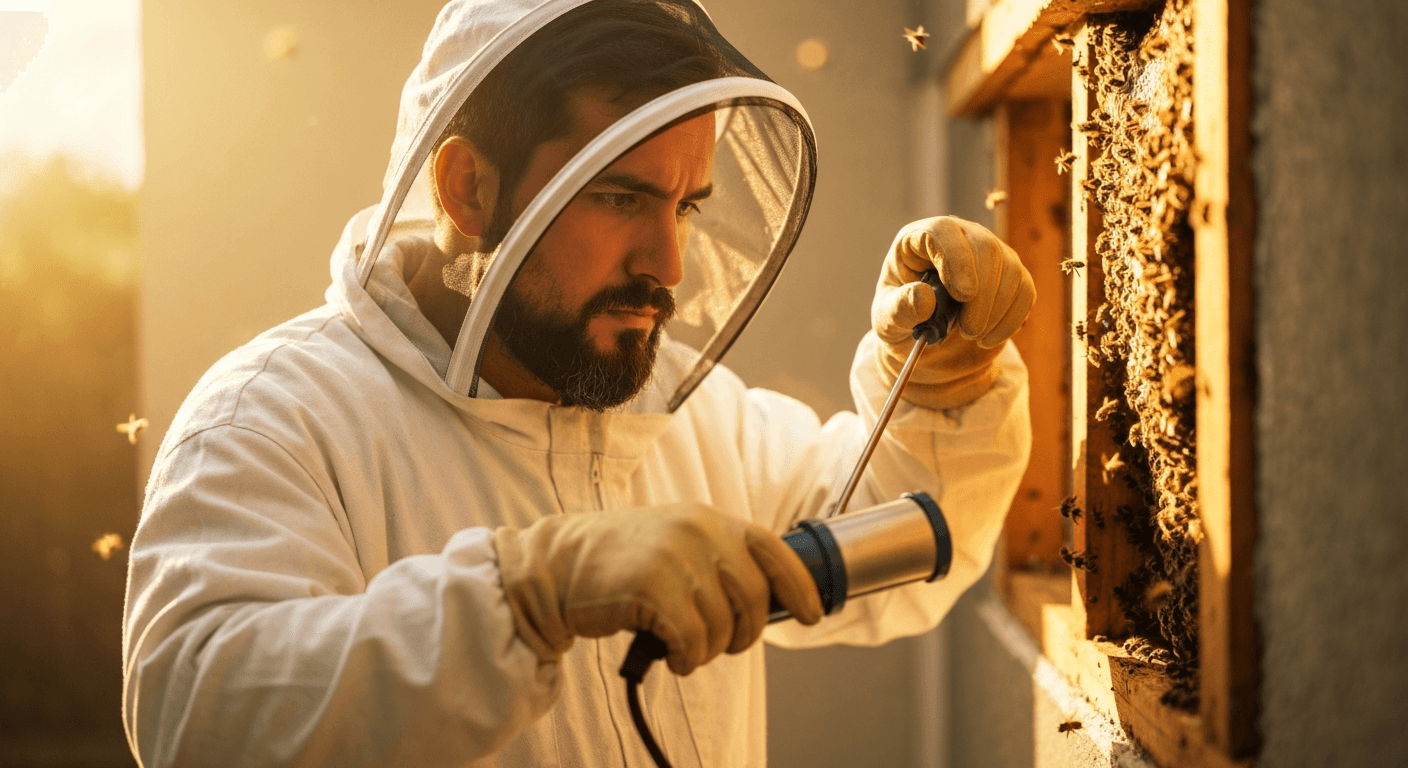
Humane Bee Removal in Orange County
Our humane bee removal service carefully relocates bee colonies without harm whenever possible, protecting both your home and the local ecosystem.
About Bee Removal
Bees play a vital role in our ecosystem, but when they build hives in or around your home, they can become a safety concern. Honeybees, carpenter bees, and Africanized bees are all found in Orange County. At Yogi's Pest Control, we prioritize humane live removal and relocation whenever possible, working with local beekeepers to give colonies a new home.
Swarm or established hive? Why it changes the job
A swarm is a cluster of bees hanging on a branch, fence, eave or mailbox, usually in spring. It is a colony that has split off and is resting while scouts look for a permanent home. Swarms are often calm because they have no comb or brood to defend, and many will leave on their own within a day or two. The risk is that they move into your wall, roof or meter box instead.
An established hive means the bees have moved in and started building wax comb, storing honey and raising brood. Signs include a steady stream of bees going in and out of one opening, buzzing in a wall or ceiling, and, in older hives, honey or wax stains on drywall. An established hive will not leave on its own and grows every season.
A swarm is a quicker, simpler removal. An established hive inside a structure means opening the wall, eave or ceiling to remove the comb, then repairing and sealing the entry.
Africanized bees: what to do right now
Africanized honey bees have been established throughout Southern California since the 1990s. They look nearly identical to European honey bees, so you cannot tell them apart by sight, but they defend their nest more aggressively, react to disturbance from farther away and can chase a person a long distance. Treat every unknown colony as if it could be defensive.
- Keep people and pets away from the bees; do not spray, throw things at or try to knock down a swarm or hive
- Do not run mowers, leaf blowers, weed trimmers or other loud equipment near the colony
- If bees start chasing you, run in a straight line to a building or car and get inside; cover your face if you can
- Do not jump into a pool; bees will wait for you to surface
- Call 911 for multiple stings, trouble breathing or swelling of the face or throat
- Scrape stingers out sideways with a card or fingernail rather than pinching them
Live removal and rehoming vs. extermination
Honey bees are important pollinators, so when it is safe and practical we remove them alive and rehome them with a local beekeeper. That is usually possible with swarms and with accessible hives that are not unusually defensive.
Live removal is not always the right call. If a colony is highly defensive, sits in a location where opening the structure is unsafe, is close to a school, play area or a person with a bee allergy, or cannot be reached without major demolition, we may need to treat the colony with a product labeled for that use and then remove the comb. We explain the options at the inspection and why we recommend one over the other.
Wasps and yellowjackets are not rehomed. Those nests are treated and removed.
Why the comb has to come out of the wall
Killing or removing the bees is only half of a structural removal. Comb left behind in a wall or ceiling keeps the smell of the old colony, which attracts the next swarm to the same opening. Without bees to fan and cool it, wax can soften and honey can leak and stain drywall and ceilings, and the leftover honey and dead brood draw ants, cockroaches, rodents and wax moths.
For a hive inside the structure, we open the area, cut out and remove the comb and honey, clean the cavity, and then close up and seal the entry point so bees cannot move back in. Sealing gaps larger than about an eighth of an inch around vents, chimneys, eaves and plumbing helps prevent new colonies.
Bees vs. wasps and yellowjackets
Honey bees are fuzzy, golden brown and build wax comb. Paper wasps are slender with long dangling legs and build open, umbrella-shaped paper nests under eaves and patio covers. Yellowjackets are shiny yellow and black, nest in the ground, walls or attics, and get aggressive around food and trash in late summer. Unlike a honey bee, a yellowjacket can sting more than once.
Knowing which one you have changes the plan and the price, so a photo from a safe distance helps when you call.
Bee Removal Cost in Orange County
| Service | Typical cost |
|---|---|
Bee inspection and assessment We identify swarm vs. hive and recommend the safest option | Free |
Swarm removal (exposed cluster) Typical for accessible swarms on branches, fences or eaves | $150 – $300 |
Established hive, accessible location Meter boxes, sheds, low eaves and similar spots | $250 – $500 |
Hive in a wall or ceiling with comb removal Depends on hive size, height and how much opening is needed | $500 – $800+ |
Wasp or yellowjacket nest removal Typical single nest | $150 – $300 |
Typical ranges. Your exact price is confirmed after a free inspection. Full pricing guide
Signs You Need Bee Removal
- Large number of bees swarming or clustering on your property
- Bees entering and exiting a wall, chimney, or soffit
- Visible honeycomb or wax on exterior surfaces
- Buzzing sounds coming from inside walls or ceilings
- Honey stains appearing on interior walls or ceilings
Health & Property Risks
- Stings can cause severe allergic reactions
- Structural damage from honeycomb buildup inside walls
- Honey attracts other pests like ants, cockroaches, and rodents
- Africanized bees are more aggressive when disturbed
Our Treatment Process
- 1Assessment of hive location, size, and bee species
- 2Humane live removal and relocation to a local beekeeper when possible
- 3Complete removal of honeycomb to prevent attracting other pests
- 4Repair and seal the entry point to prevent future colonization
- 5Cleanup of any honey or wax residue
Prevention Tips
- Seal cracks and holes in exterior walls, eaves, and soffits
- Cover or cap unused chimneys and vents
- Fill holes in the ground that could attract ground-nesting bees
- Remove old equipment, furniture, or debris where bees could nest
Frequently Asked Questions
Do you kill the bees?
How much does bee removal cost?
Will a bee swarm leave on its own?
Can I just spray the bees and seal the hole?
How do I know if the bees are Africanized?
Do you remove bees from chimneys, meter boxes and irrigation boxes?
Bee Removal Near You
Related Guides
Page updated 2026-10-19
Related Services

Need Bee Removal?
Schedule your free inspection today. We'll create a custom treatment plan for your property.